Profile: PlantPAx Distributed Control System

High-Level Implementation of Distributed Control System

Overview:

Process control systems, sometimes called industrial controls systems (ICS),  function as pieces of equipment along the production line that test the process in a variety of ways and return data for monitoring and troubleshooting.

We’ve studied process control systems in detail in class. Based on my research of the industrial application of process control systems, I was able to identify the four vital elements of industrial process control systems: a measurement that indicates the current status of the condition of the process, a controller to take action based on that measurement and a set value, an output signal to manipulate the process that results from the controller, and the process in its entirety that reacts to the signal (input or output). 

Distributed Control Systems are specially designed systems to control complex and geographically distributed processes. These controllers are distributed in the entire plant area; discrete field devices such as actuators and sensors are connected to these controllers and also maintain continuous communication with operating PCs through a high-speed communication network. 

The basic element of the DCS system is an engineered PC controlling the distributed controllers, which then control connected field devices. An operating station is used to monitor the field parameters graphically and to log the data (and communication media to establish data transfer between the controllers and the operating stations). DCS facilitates the human machine interface, trend display and face plates for the effective monitoring of industrial processes. 

Chosen System: PlantPAx Distributed Control System

Overview: The PlantPAx system uses a common automation platform for integration between the critical areas of a plant. The modern DCS connects process, discrete, power, information, and safety control into one plant-wide infrastructure. 

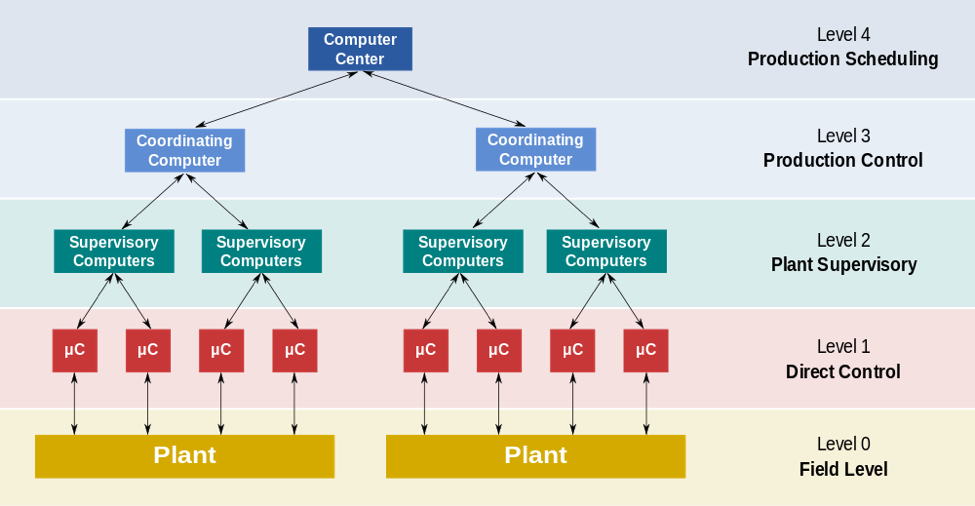
The key “levels” of control of the PlantPAx are as follows:

  • Level 0 constitutes the field devices: these are the devices that measure the flow or temperature of the plant, and final control elements like control valves.
  • Level 1 contains the industrialized input/output modules and the distributed electronic processors associated with these modules.
  • Level 2 contains the supervisory computers which collect information from processor nodes on the systems, and provide the operator control screens.
  • Level 3 is the production level which simply monitors the production and targets.
  • Level 4 is the production scheduling level.

Level 1 and 2 are the functional levels of traditional DCS, where all equipment is part of an integrated system from a single manufacturer. The processor nodes and operator graphical displays are connected over proprietary or industry standard networks. Processors receive information from input modules and then process the information and decide control actions to be signaled by the output modules. The field inputs and outputs can be analog signals or two state signals that simply switch on and off. The DCS is connected to the sensors, and uses the methods of set-point control that we have studied to control the flow of material through the plant. Most of the systems in chemical plants use PID controllers: the PID controller is fed by a flow meter using a control valve as the final control element. The DCS will then send the set-point required by the process to the PID controller which signals the valve to operate so that the process achieves the set-point. Most large chemical plants have several thousand input and output points and thus utilize large DCS. This semester, we studied the transfer functions that describe PID control: the equation includes terms for proportional, integral, and derivative control, but I appreciated learning about DCS systems because we can see the larger scale application of these control systems in an integrated plant. In the temperature lab, for example, we observed how proportional control on its own is an inefficient means of controlling processes due to steady-state offset, and we saw how playing with the integral and derivative terms of a PID controller can reduce off-set and minimize oscillations. Essentially, we learned that PID is typically the most effect means of controlling a system. However, the information I learned while compiling this profile on the DCS system illustrated the application of the PID controller in large-scale chemical plant. 

References:

Process Control Safety Failure: The Carcinogenic Contamination of Losartan

The Food and Drug Administration Commissioner Scott Gottlieb recently shared that the agency has hired dozens of chemists to review pharmaceutical companies’ manufacturing techniques after an influx in impurities found in tablets. Most recently, Sandoz Inc. recalled Losartan potassium hydrochlorothiazide, a blood pressure drug, due to contamination by the probable carcinogen N-nitrosodiethylamine. NDEA, an organic chemical used for the production of rocket fuel, is a byproduct of manufacturing some pesticides and processing fish. Patients currently taking the drug were encouraged to speak with their pharmacists and doctors immediately, as discontinuing use of the drug might cause greater harm to the patient than a small increase in risk of cancer. It is still unclear how immense the risk of cancer might be from ingesting the contaminated tablets—if 8,000 people took the highest dose of the drug, there might be one additional case of cancer over the lifetimes of these 8,000 high blood pressure patients. 

Of course, the API’s manufacturing plant underwent rigorous investigation. The active pharmaceutical ingredient was manufactured by the Zheijian Huahai Pharmaceutical Co. in Linhai, China. The FDA inspected the facility and identified several poor manufacturing practices: at the plant, the unintentional production of NDEA was a result (and really a product) of certain chemical reactions taking place on a large scale at the plant. The company has since been placed on import alert by the FDA, so both its APIs and finished products are prohibited from entering the United States. 

Losartan tablets are meant to treat hypertension and even lower risk of stroke in patients; the notion of the drug inducing cancer in some patients due to poor manufacturing practices demonstrates the importance of chemical process safety and contamination prevention. Process safety is especially critical in the pharmaceutical industry, where products that are meant to improve the human condition can actually harm patients. 

That said, there are safeguards against contamination in place, even in the plant that produced Losarton. For example, contaminant solutions are used to ensure materials aren’t exposed to foreign substances. Or, flexible polymer enclosures stop chemicals and powders from coming into contact with the outside world. 

I took a particular interest in the news of this instance of contamination, because I’ve actually had the opportunity to observe a functioning pharmaceutical chemical processing plant and the measures in place to safeguard against contamination. Attached is a picture of Pfizer’s Kalamazoo plant, which manufactures many of the company’s APIs and sterile injectables, as well as those outsourced from other companies through their Contract Manufacturing Organization (which I interned for). While very little public information on the actual process control methods utilized in the plant producing Losarton was available, I hypothesized that a potential source of the unintentional production of NDEA could have been either imperfect control of temperature or pressure during reactor stages of manufacturing, or ineffective control of reactant or product concentrations. With many large-scale chemical reactions occurring simultaneously, process control is clearly imperative to ensuring undesirable byproducts are not formed, in turn putting the health of patients at risk!

Pfizer’s Kalamazoo API and Sterile Injectables Plant

References:

Click to access P-721.pdf

BREAKING: October 2018 Biopharma News – Mannogem-XL Revolutionizes Formulation Performance

Background:

Control strategies for continuous versus batch manufacturing differ; in continuous manufacturing, controlling processes and simultaneously maintaining quality is a key concern. On the other hand, variation in quality in space is more of an issue for batch processes. In recent years, the biopharmaceutical industry has seen a shift in objective from Quality by Testing to Quality by Design, largely due to model predictive control as a control strategy. Through simulations, it has been proven that MPC can improve closed-loop performance of continuous tablet manufacturing in pharmaceuticals, but the application of this advanced control system will be challenging due to the complexities of solid handling, variable flow, and sensing challenges. 

In the abstract I studied to gather background information on traditional control systems in tablet manufacturing, a PID control system was implemented in a compaction continuous tablet plant. I will consider the blender and the variables around the blender here: a sensor reads the data at the blender outlet which is then communicated to the model to adjust the API concentration – API concentration and relative standard deviation value are known as “critical quality attributes” and are then used as inputs to the PID control systems. The MPC then uses these two inputs to adjust the feed ratio and the blender speed, the controlled variables. The PID MPC system sets the feeder flow rate set point, while slave PID controllers track these flow rate set points. 

News Overview:

This fall, SPI Pharma launched Mannogem XL mannitol for the production of various forms of tablets: the product delivers a formulation of mannitol that provides improvement in critical quality attribute achievement and disintegration properties. SPI Pharma claims that the product will create tablets with 25% improvements in tablet hardness and 38% quicker disintegration per tablet hardness. Ultimately, the product is a form of direct compression that provides improved binding and disintegration—this means it can advance development and lower overhead costs as it performs as a binder facilitating quicker disintegration. In process control terms, Mannogem XL will reduce deviation from the set-point value of API concentration altogether: eliminating a portion of the burden on the P, I, and D terms to control the API concentration proportionally, based on deviations over time, and based on the rate of those deviations, respectively. This did spark a question: what is the accepted sensitivity of PID controllers in pharmaceutical manufacturing and could an anticipated decrease in deviation require a more sensitive controller?

 In theory, the product should revolutionize pharmaceutical manufacturing, as the companies that purchase and implement Mannogem XL should see an improvement in the precision of dosage consistency, by reducing deviation from the set point from the start.

Ultimately, the product is meant to enable manufacturers to experience fewer failures and create higher yields: it maintains tableting rates by advancing the process control by design, in turn, facilitating the advancement in Quality by Design across the industry. And that is newsworthy (assuming the product is as effective as testing indicated)!  

References:

https://www.in-pharmatechnologist.com/Article/2018/10/30/SPI-Pharma-promises-fewer-failures-and-higher-yield-with-Mannogem-Xl

https://www.spipharma.com/en/products/functional-excipients/mannogem-xl/

Click to access mannogem-xl.pdf

Departmental Seminar: Control of Engineering Metabolism Using Subcellular Engineering and Optogenetics

Avalos’ seminar illustrated a form of metabolic engineering (this is the practice of optimizing genetic and regulatory processes within cells to increase the cell’s production of a substance of interest). This can mean the production of advanced biofuels, which are fuels that can be produced from biomass (plants, animal waste, etc.). In Avalos’ research, the cells are engineered with the objective of producing more of the products of interest—isobutanol, 2-methyl-1-butanol, and 3-methyl-1-butanol. In essence, the yeast in use prefers to make ethanol from glucose, so in order to make the other alcohols, the cells’ metabolic pathways must be engineered. 

Each subcellular compartment in yeast offers a unique physiochemical environment as well as distinct metabolite, enzyme, and cofactor compositions, which may benefit the activity of metabolic pathways. Organelles are important because they can compartmentalize different metabolic reactions and their proteins. 

Optogenetics can be applied to metabolic engineering by supplying the fine-tuning of timing and levels of expression of metabolic enzymes in metabolic pathway optimization. In reactions, timing is important. Enzymes must be activated and in high enough concentrations to yield product. Avalos uses light-sensitive transcription factors, which are basically molecules that make enzymes from DNA, to control when enzymes are expressed in big cell populations. In this way,  Avalos’ work is an example of successful localization in yeast.

Optogenetic controls are ideal as light can be applied and removed instantly. As discussed, periodic light pulses are used to tune the levels and timing of enzyme expression during fermentation to boost yields. There are a few factors that make dynamic control with light especially useful:

  1. It is easy to dose and tune
  2. It is both instantaneous and reversible
  3. It is not restricted by media

Ultimately with optogenetic controls, 10x more isobutanol and 2-methyl-1-butanol can be made from glucose. This form of control combines both spatial and temporal control, by engineering organelles that respond to light. In simple terms, the light is used to facilitate growth and the dark is used to facilitate production. The ethanol is produced under light and when some biomass is reached the light is turned off to then make isobutanol. In the end, Avalos is able to promote enzyme expression in cells, ultimately promoting metabolic reactions and increasing the yield of isobutanol through compartmentalization and optimization with light-sensitive TFs, changing the landscape of bioreactor operation.

Video: PID Controller in Action

Video Source: https://www.youtube.com/watch?v=X-8Efdq3bcU

The video demonstrates the startup and implementation of temperature control in a distillation column at a small brewery. During the process, the temperature of the ethanol needs to be maintained so that the ethanol doesn’t overcook, scorch or undercook. At the same time, manually controlling the temperature throughout the process would be inconvenient and unnecessarily challenging. This is where the PID controller comes in! 

In order to introduce the theory of automatic process control, the video’s author compared the controller to a home thermostat, which primarily turns the heat on and off as the temperature of choice is reached. With a PID controller, there is a flow of current as the PID controller adjusts its output (which is determined by the P, I, and D gain equations we learned in class—which the video’s author describes as a “very long set of mathematical equations” :). Clearly the controller response is dependent on the deviation of the system from the set-point. The PID controller fine-tunes until it is able to maintain the temperature required for the column. Ultimately, the video was instrumental in supplementing my understanding of the theory behind PID controllers from class as well as my experience observing the effectiveness of different control parameters in response to disturbance variables in systems studied in lab. 

I actually watched the next video in this series to see how the author wired the physical PID controller as we haven’t had a chance to observe the physical mechanism of PID controllers yet. Additionally, from this video, I gained insight on the economic feasibility of obtaining a PID controller for an independent process or project.  PID controllers are actually quite inexpensive (only $16 in this case), and come in a variety of forms. Still, I’d be interested in looking into the cost of fully integrated PID controllers for larger-scale, industrial processes.